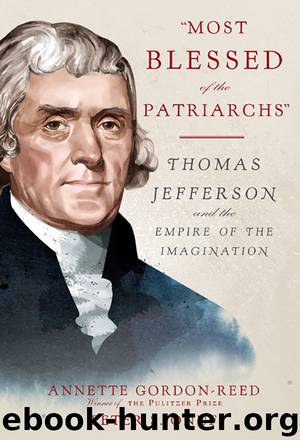
Most Blessed of the Patriarchs by Annette Gordon-Reed
Author:Annette Gordon-Reed
Language: eng
Format: epub
Publisher: Liveright
FRANCE ON THE EVE of its great revolution—the France Jefferson knew and loved—without question left an indelible imprint on his mind and manners. Despite the claims of his enemies, however, Jefferson eschewed the “philosophical” radicalism they imputed to him. If engaged fellow citizens preserved their rights and thus vindicated the revolution’s promise, successive generations of Americans would enjoy the peace, prosperity, and happiness Jefferson envisioned for them in the Declaration and reaffirmed in his first inaugural address. This was a vision of American exceptionalism, and a beacon to oppressed peoples everywhere. The French had struck the first bloody blow in their own struggle for national self-determination. One day, Jefferson prayed, they too would enjoy the great boon of republican self-government.
In the meantime Jefferson acknowledged his debts to France. When he returned to America, he fashioned himself as an emissary from the French Enlightenment, attracting admirers and followers as he performed the role of learned savant and cultured man of the world. No American could match his cosmopolitan sophistication, and he quickly grasped the advantages he had gained from his years abroad. When he served in the Continental Congress, Jefferson was known for his literary skills and dedication to the republican principles he articulated in the Declaration. But otherwise, John Adams recalled, Jefferson did not make much of an impression: modest in manner and a poor public speaker, although he was said to have been good in a courtroom, he did not make a show of himself in those days. The cosmopolitan Jefferson who returned from Paris stood out much more conspicuously, shaping a new self-image by exploiting the cultural capital now at his command.
Jefferson’s manner was distinctive; so were the ways he dressed and the settings he created for himself in his homes away from home.29 The many crates of furniture, furnishings, tableware, paintings, and art objects that he had shipped from Paris to New York provided props for his stylish performances. Jefferson simultaneously became more self-consciously “American” and more “French,” eagerly adapting the ethos of the great French metropolis to life in the new nation’s temporary capitals and introducing his countrymen to the best French wines and cuisine. He even ate in the European style. “He would have his plate changed several times during dinner, a habit not observed, in those days, by country gentlemen generally,” Ellen Coolidge said, remembering that a cousin who had lived for a time in Europe told her that Jefferson’s was “the only table in the country where [he] would dare ask for a clean plate.” As for what was on his plate, Jefferson was partial to French fare and French-style cooking. Coolidge said of her grandfather’s tastes, he “liked boiled Beef, Bouilli [a form of stewed beef], better than roast. He ate a great many vegetables and little meat, contrary to the custom of his countrymen.” There is no doubt about his preferences for wine. Coolidge stated firmly, and additional evidence bears this out, that Jefferson “preferred french wines to Madeira or Sherry.”
Download
This site does not store any files on its server. We only index and link to content provided by other sites. Please contact the content providers to delete copyright contents if any and email us, we'll remove relevant links or contents immediately.
Fanny Burney by Claire Harman(26616)
Empire of the Sikhs by Patwant Singh(23094)
Out of India by Michael Foss(16865)
Leonardo da Vinci by Walter Isaacson(13351)
Small Great Things by Jodi Picoult(7171)
The Six Wives Of Henry VIII (WOMEN IN HISTORY) by Fraser Antonia(5524)
The Wind in My Hair by Masih Alinejad(5110)
A Higher Loyalty: Truth, Lies, and Leadership by James Comey(4975)
The Crown by Robert Lacey(4826)
The Lonely City by Olivia Laing(4811)
Millionaire: The Philanderer, Gambler, and Duelist Who Invented Modern Finance by Janet Gleeson(4492)
The Iron Duke by The Iron Duke(4372)
Papillon (English) by Henri Charrière(4283)
Sticky Fingers by Joe Hagan(4211)
Joan of Arc by Mary Gordon(4125)
Alive: The Story of the Andes Survivors by Piers Paul Read(4042)
Stalin by Stephen Kotkin(3976)
Aleister Crowley: The Biography by Tobias Churton(3651)
Ants Among Elephants by Sujatha Gidla(3475)
